

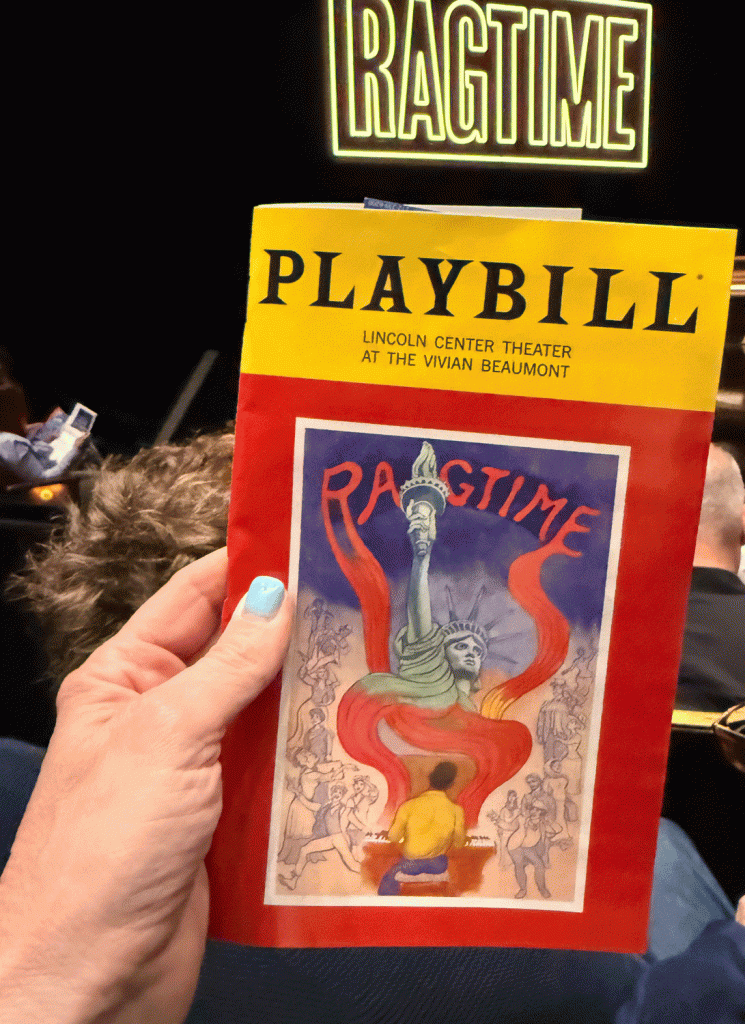
The Broadway revival of Ragtime at Lincoln Center’s Vivian Beaumont Theater is the kind of production that stays with you long after you leave your seat. It is grand in scale, emotional in impact, and deeply rooted in the social wounds of early 1900s America. At the same time, it feels startlingly current. This is not just a revival of a beloved musical. It is a reminder that many of the struggles at the heart of the story—racism, xenophobia, class inequality, and antisemitism—still shape the world around us.
I saw Ragtime at a Sunday matinee, and many of the performers onstage appeared to be understudies. But, it didn’t matter. The cast was phenomenal from top to bottom. In a show this large and emotionally demanding, that says a lot. With around 30 cast members, including three children, this is a true ensemble production, and the power of the piece comes from how fully everyone commits to it.
A sweeping story built around three families
At its core, Ragtime follows three very different families whose lives gradually intersect in New York at the start of the twentieth century. One is a white Christian family living in New Rochelle. Another is a Black family in Manhattan. The third is a Jewish immigrant family trying to survive and build a future in a new country.
That structure gives the musical both intimacy and scope. You are not just watching one household’s story unfold. You are watching America try, and often fail, to live up to its ideals. Each family carries its own burdens, hopes, and identity, and the show carefully reveals how race, class, and prejudice shape each path.
What makes Ragtime so effective is that it never lets these themes feel abstract. The personal and the political are always tied together. The pain feels human. The injustice feels specific. And the hope, when it appears, feels hard-won.
Why the story still hits so hard
Although the show is set in the early 1900s, it does not feel locked in the past. If anything, that is what makes it so devastating. The treatment of immigrants, the open bigotry, the racism, and the sense that wealth and power protect some while crushing others all feel painfully familiar.
There were moments in this production when it was hard not to think about the present day. The rich still get richer. Immigrants are still treated with suspicion and hostility. Antisemitism remains real and persistent. Racial injustice continues to define American life. Ragtime may be a period piece on paper, but in performance it feels like a mirror.
A cast that brings enormous emotional force
This revival succeeds because the cast gives the material real weight. Even in a production filled with strong performances, several stood out.
John Clay III as Coalhouse Walker Jr. delivered one of the evening’s most memorable performances. Coalhouse is a role that demands intensity, vulnerability, pride, and heartbreak, and Clay brought all of that to the stage. His performance had force behind it, but it never lost the humanity that makes the character so tragic.
Lauren Blackman as Mother was another standout. Mother’s arc is one of the most compelling in the show, and Blackman captured both her grace and her quiet transformation. She brought warmth and intelligence to the role, and she gave the character a steady emotional center. Her presence grounded many of the show’s biggest moments.
Brandon Uranowitz as Tateh was deeply affecting. Tateh’s story as a Jewish immigrant trying to create a better life carries so much of the show’s tenderness and resilience. Uranowitz gave the role emotional depth without overplaying it, which made his journey land even more strongly.
Nichelle Lewis as Sarah brought beauty and heartbreak to the role. Lewis gave the character dignity and emotional clarity, and her performance lingered.
Shaina Taub as Emma Goldman added spark and conviction whenever she appeared. Emma Goldman can function almost like a moral and political current running through the story, and Taub made that energy vivid. She brought both fire and purpose to the role.
A true ensemble piece
As strong as the featured performances were, this Ragtime review would be incomplete without stressing how good the full company was. This is a huge cast, and there is no way a show like this works unless the ensemble is fully locked in. They were.
That mattered even more given the fact that several understudies seemed to be performing that afternoon. Rather than feeling uneven, the production felt unified. Everyone onstage seemed fully invested in telling the story. The result was a performance that felt rich, polished, and emotionally alive.
The score carries the production
This is a song-heavy musical, and that works in its favor. The score does much of the storytelling, and in this production, the music gives the evening its heartbeat. The songs have an old-fashioned theatrical quality that fits the period beautifully. They feel rooted in the early twentieth century without becoming stiff or museum-like.
That musical style helps shape the world of the show. It gives Ragtime a sense of grandeur, but also of longing. The score can swell, ache, and confront all at once. It is one of the reasons the musical feels so emotionally layered.
Because so much of the show is sung, the performances need to communicate character and conflict through music as much as dialogue. This cast did that well. The songs did not just sound impressive. They moved the story forward.
Minimal set, major impact
One of the more striking things about this Broadway revival of Ragtime is how simple the set design is. The staging is fairly minimal, especially compared to the emotional and historical scale of the material. But it works.
Instead of overwhelming the story with too much scenery, the production lets the performers, music, and themes carry the weight. That choice gives the show a kind of clarity. Your focus stays where it should: on the people, their suffering, and their connection to one another.
At the same time, the production still feels big. This is unmistakably a major Broadway staging. The scale comes from the cast, the music, and the sweep of the storytelling rather than from an overly busy set. That balance is one of the production’s strengths.
Costumes that fully evoke the period
If the set is stripped down, the costumes do a great deal of visual storytelling. They are right in line with the period and help establish the world immediately. More than that, they are often simply beautiful.
Mother’s costumes, in particular, stood out. They were gorgeous and gave the character an elegance that supported her role in the story. In a show so concerned with identity, status, and social performance, the costumes do more than look good. They help define how these characters move through the world.
A moving but very long night at the theater
There is no way to talk about this revival honestly without mentioning the runtime. Ragtime lasts nearly three hours, which is a long sit for any musical. The material is strong enough to sustain that length, but you do feel it.
Part of that comes down to the theater itself. The seats felt cramped, and by the end of the performance my knee was definitely paying the price. If the seating had been a little more comfortable and a little less tight, the length might not have felt as noticeable. But in the Vivian Beaumont, physical comfort became part of the experience, and not in a good way.
That said, the show remained emotionally engaging throughout. Even at its length, it never felt empty. It felt full—of music, ideas, pain, and urgency. Still, if you are going, it is worth being prepared for a long performance and snug seating.
What this Ragtime revival does best
The Broadway revival of Ragtime at Lincoln Center’s Vivian Beaumont Theater is emotional, engaging, and deeply relevant. Even with several understudies performing during the Sunday matinee I attended, the cast was exceptional. John Clay III, Lauren Blackman, Brandon Uranowitz, Nichelle Lewis, and Shaina Taub all left strong impressions, and the ensemble as a whole gave the show its force.
This is a production that trusts the material. It does not overcomplicate the staging or soften the message. Instead, it lets the story’s themes of racism, bigotry, immigration, and inequality speak with unsettling clarity. Yes, it is long. Yes, the seating is cramped. But Ragtime is the kind of show that reminds you why theater matters in the first place. It asks you to look at the past, then recognize how much of it is still here.