

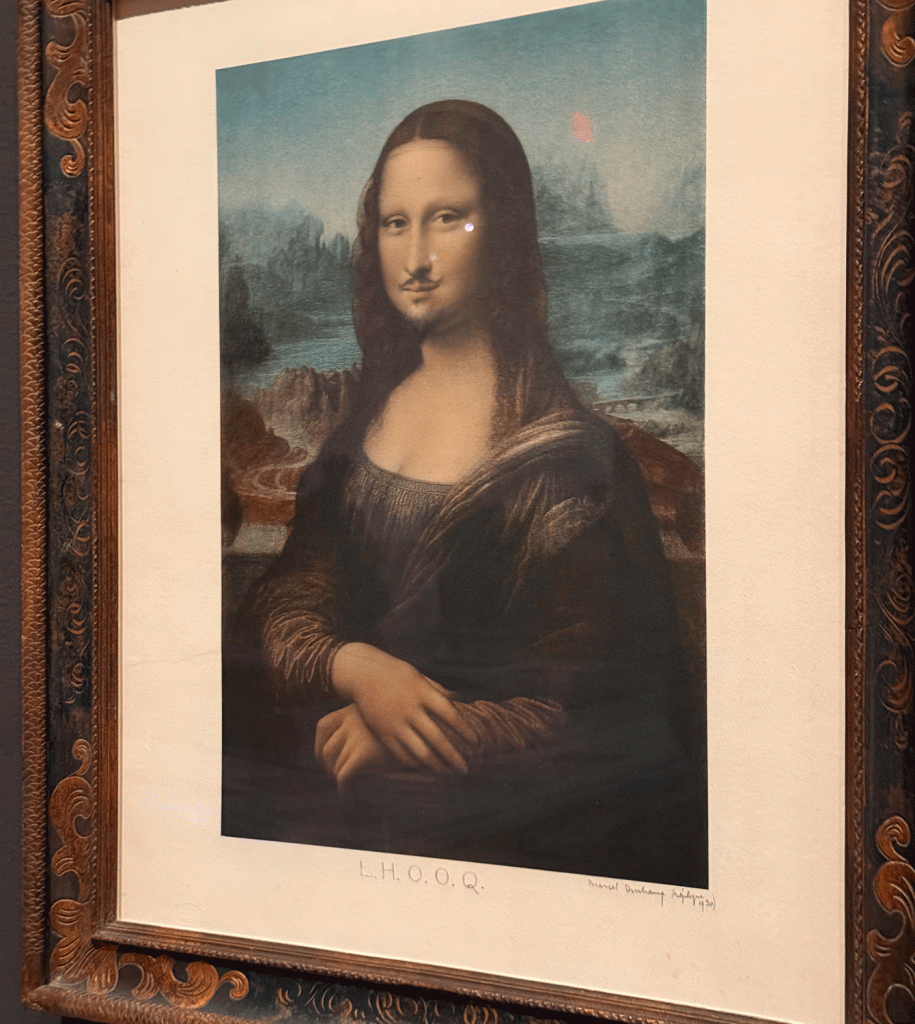
There are museum visits you enjoy, and then there are museum visits that stay with you. My husband and I had the second kind recently at the Museum of Modern Art in New York, spending an afternoon with Marcel Duchamp’s work — and I have been thinking about it ever since.
Starting at the Beginning
What struck me first was how young and almost conventional his earliest work feels. Before Duchamp became Duchamp — the provocateur, the chess obsessive, the man who submitted a urinal to an art exhibition and called it sculpture — he was a painter making his way through the styles of his time.
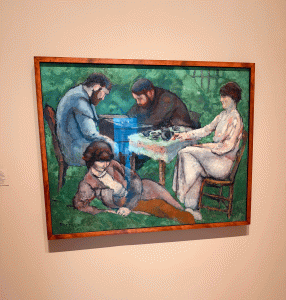
His early pieces carry echoes of Post-Impressionism, loose and expressive but grounded in recognizable form. Standing in front of them, I found myself thinking: this is a man who clearly could paint, who understood the rules before he decided to tear them up. That context made everything that came later feel more deliberate.
The Cubist Turn
Then came the Cubist period, and the shift is genuinely exciting to witness in person. Duchamp’s most famous painting from this era, Nude Descending a Staircase, captures motion in a way that still feels fresh over a century later. The figure fragments across the canvas in overlapping planes, suggesting movement through time rather than freezing a single moment.
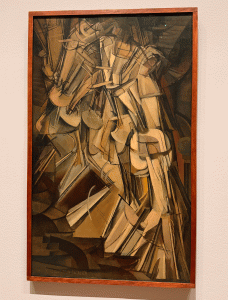
When it was first exhibited in 1913 at the Armory Show in New York, it caused a sensation — critics mocked it, the public was baffled, and Duchamp became famous almost overnight. Standing in front of it now, you can see both why it was controversial and why it endured. It is not comfortable art. It asks something of you.
What I appreciated most about tracing this period was seeing how Duchamp used Cubism as a launching pad rather than a destination. Where other artists committed fully to the movement, he was already restless, already thinking about what came next. You can feel the momentum in the work — a mind that cannot stay still.
The Later Work and a Life Fully Lived
The later pieces are where things get genuinely strange, and I mean that as a compliment.
By the time Duchamp moved into Dadaism and his now-legendary “readymades” — everyday objects recontextualized as art — he had essentially redefined what art could be. Seeing those ideas traced back through his earlier development made them feel less like provocations and more like a logical endpoint. This was where his thinking had been heading all along.
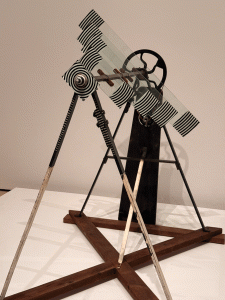
Duchamp died in 1968, and there is something poignant about standing before the work he made in the final stretch of his life. He had spent decades being ahead of his time, influencing generations of artists who came after him, and then quietly disappearing from public view to pursue his passion for chess. The work from his later years has a stillness to it — not resignation, but a kind of settled clarity.
What to Know If You Go
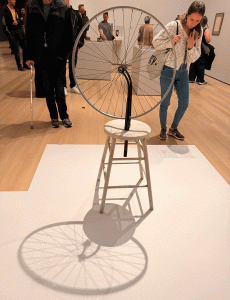
MoMA’s collection is vast, and Duchamp’s work sits within it rather than as a dedicated standalone exhibition, so it helps to do a little research before your visit and know which pieces you want to prioritize. Give yourself more time than you think you need.
Duchamp spent his life questioning what art could be. An afternoon with his work will leave you questioning a few things too — which is, I think, exactly what he had in mind.