


I go to a lot of shows. Some make me laugh, some make me think, and every once in a while one leaves me speechless. The Hope Theory did all three. I walked out of New York City Center, on West 55th Street, with my heart full, my mind spinning, and a story I’ll be telling for years, because I ended up being part of the magic.
A Memoir Told Through a Deck of Cards
The Hope Theory is a 90-minute one-man show written and performed by Portuguese magician Helder Guimarães. Academy Award-winning producer Frank Marshall, the name behind Raiders of the Lost Ark and The Sixth Sense, directed it. The Geffen Playhouse in Los Angeles originally produced it. Fittingly, that’s also where Helder got his start after landing a job there.
At its heart, this show is a memoir. Helder takes us through his journey of immigrating to America and his long, uncertain fight to get his girlfriend, Caterina, her green card too. Inspired by The Hope Theory book, the show asks what keeps us going when the finish line feels impossibly far away.
As an athlete, I know that feeling well. Hope is what carries you through mile 20 when your legs are screaming. Helder captures that same stubborn optimism, except his race is through paperwork, waiting rooms, and a system that doesn’t always make room for people who weren’t born here.
Magic That Moves the Story Forward
What makes this show so special is how the magic and the storytelling work together. The card tricks aren’t just party tricks tossed in between scenes. Each one helps tell the story. A shuffle becomes a metaphor for chance. A card that shows up exactly where it shouldn’t becomes a moment of hope.
I spent half the show trying to figure out how he did it. I spent the other half not caring, because I was too caught up in his story.
The Apartment That Came to Life
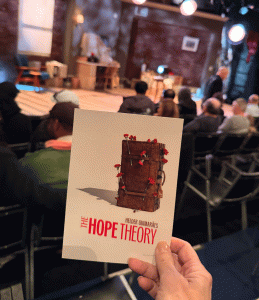
The set is an apartment, and when the show begins, it’s not quite a home yet. As the story unfolds, Helder unboxes it piece by piece. Boxes open, and an empty space slowly fills with life.
It’s such a smart choice. Anyone who’s ever moved knows that feeling of standing in a new place surrounded by cardboard, wondering if it will ever feel like yours. For an immigrant, that feeling goes so much deeper. Watching the apartment come together alongside his journey was quietly powerful.
The Heart of the Immigrant Experience
This is where The Hope Theory really got me. Helder speaks openly about the challenges he faced as an immigrant and the ways people treated him differently because he wasn’t born here.
He also made an observation that stuck with me. He noted how interesting it is that select groups often form enclaves and stay together in new countries. It made me think about the neighborhoods I’ve explored in New York and on my travels, and why people find comfort in the familiar when everything else feels foreign. By the end of the show, he tied this idea together beautifully.
He also shared the significance of April 25, the day in 1974 when Portugal broke free from dictatorship. Hearing him talk about it gave me a new appreciation for what freedom means to people who remember life without it. It added real weight to his story and helped explain the hope that drives him.
It was emotional, honest, and beautifully written. I wasn’t the only one reaching for a tissue.
And Then… I Became Part of the Show
The Hope Theory has a lot of audience interaction, so if you love being part of the action, you’re in luck. And yes, I got picked.
Helder threw a “Cookie Monster” doll randomly to someone in the audience. That person threw to another and so on. Those five people stood, and I was one of them. He had us each draw a number from a lottery ball bag. I pulled 42. The other four people drew their own numbers, too. Then he asked each of us where we were from. I proudly said, “Long Island!”
On the next round, Helder wrote down all of our numbers. Every single one was correct, including my 42. The audience gasped, and honestly, so did I.
But he wasn’t done. He asked the five of us to stand again and share the card number we’d been handed when we walked through the door. Mine was 8. Somehow, he identified every number, including mine. I had that card in my hand since I walked in, and I still have no idea how he knew.
I laughed, I clapped, and I left completely amazed.
Tips Before You Go
If you’re planning a trip into the city to see The Hope Theory, here’s what you should know:
- Run time: 90 minutes with no intermission
- Arrive early: There’s no late seating or re-entry, so give yourself plenty of travel time
- Tickets: Start at $79
- Age: Recommended for ages 12 and up
- Groups: If you’re bringing 10 or more people, City Center offers group sales
- Make a day of it: Grab an early dinner in Midtown before the show so you’re not rushing
Go See It…
The Hope Theory is a fantastic show, and I highly recommend it. It’s funny, mind-blowing, and deeply moving all at once. Whether you love magic, theater, or a story that reminds you why we keep pushing forward, it’s worth the trip.
It’s playing at NYC City Center for a limited engagement, so don’t wait too long to grab your tickets. Treat yourself, bring a friend, and maybe, just maybe, you’ll be the one drawing a number from that lottery bag.